Introduction

The Rover by Aphra Behn is one of those plays that I read at the tail end of my undergraduate journey. When we picked it up again for this seminar, I recalled enjoying it, and recalled that I thought it would be a fun show to design the costumes, as so many of the characters cycle in and out of various disguises. My undergraduate course focused on Behn as a female playwright who was writing for English acting companies that, for the first time, included women in their number. We did not exactly delve into the themes and issues of the play. We read The Rover to learn what it told us about theatre at the time, not to examine it as a work of literature.

I enjoyed this play, reading it again several years later. And I thought it provided a nice symmetry, for me to delve into the research of The Rover at the tail end of my graduate journey. As feels natural to me, I once again latched onto the portrayals of women in The Rover. Behn created a spectrum of female characters in this play, who all have different tactics of obtaining what they want. However, their goals seem to circle around each other – obtaining independence, whether through marriages of their choice or financial security. I found these contrasting tactics paired with mirroring goals interesting, and really informed my journey through the research and analysis of this play.

I was also very interested in the costuming of this play. Behn clearly states in the stage directions at multiple points that the characters come in dressed in masquerade garb, or dressed in specific costumes. Then the stage directions will later state that a character enters in masquerade costume again, but in a different costume from before. As an example, Florinda has six different costumes as a character, but three of those are Carnival disguises. I found this an extravagant amount, especially since this play was written when costumes were either pulled from the acting company’s stock of donated clothing, or provided by the actors themselves. But, as a modern designer, this does prevent a delightful opportunity to design and research a wide variety of period costumes, and figure out how to ensure the audience never gets confused about which masked character is which.

Overview of the play

The Rover follows a group of characters, brought together by their connections to four banished Cavaliers from England. Due to the play occuring during Carnival in Naples, Italy, society is relaxed, less strict, and the common use of masks and disguises allows the characters to move and interact with each other in less-inhibited ways.

The play begins with sisters Florinda and Hellena discussing love. Hellena, who is supposed to take her religious vows and join a nunnery once Lent begins, teases and begs her sister to tell her what love feels like. Florinda demures, but eventually it is revealed that she is in love with Colonel Belvile, an English soldier who defended her during a siege at Pamplona. However, they are soon joined by their brother, Don Pedro, who pushes Florinda to think fondly on Don Vincentio (who her father wants her to marry), or, if not on him, to put her affections on Don Antonio. Antonio and Pedro are friends, and Antonio is also wealthy and powerful. Hellena scorns Don Vincentio, and Pedro for condemning his sister to marry an old man, and Pedro responds by reminding Hellena that she is destined to be a nun. He then tells Callis, the girls’ governess, to keep them inside and not let them roam the streets, and goes out to enjoy Carnival. His orders are in vain, for Cousin Valeria arrives with costumes, and the girls go to dress and enjoy their Carnival freedom.

We next meet Belvile, Frederick, and Ned Blunt – three English cavaliers who are trying to enjoy their time in Naples. Belvile is glum, because he loves Florinda but her brother has barred him from the house. They are soon met by Willmore, their friend and a naval captain who has just arrived in Naples. They flirt with some passing women and snipe at each other, and soon, Florinda, Hellena, and Valeria arrive on the scene, masked and disguised as gypsies. Hellena and Willmore flirt, and Willmore is very taken by her wit and bold words. She promises to meet him later. Florinda and Belvile speak, but he does not initially realize who she is and is cold, as he is determined to be faithful to Florinda. She gives him a letter and flees with her kinswomen when she sees her brother approaching. Belvile recognizes the handwriting and realizes that Florinda is telling him to come carry her off that night to escape her brother. Blunt, who has been speaking to another woman, Lucetta, leaves with her – the other Englishmen laugh over this, hoping that she’ll make a fool of him so they can continue to laugh at him, but they realize he has all their money and hope he won’t be made a fool of too soon. They leave, for other amusements.

Belvile, Willmore, and Frederick are on their way to see what this business of a courtesan selling herself is, and they come upon Blunt again. He is completely taken by Lucetta, and the other men laugh and advise him to not be so in love as they take their money back. They reach the house of Angellica Bianca as her servants are putting up several portraits of her. The Englishmen agree that she is beautiful, but the price of a thousand crowns a month is far too high, so they leave. Don Pedro arrives, sees the price, and goes off to fetch the money – his uncle was Angellica’s former lover, and he had fallen in love with her when she was beyond his reach. Don Antonio is also interested in Angellica, and Pedro overhears his servant reminding him that he is supposed to marry Florinda – but Antonio tells his servant that it doesn’t matter, he can have Angellica and still marry Florinda. Pedro is offended for his sister’s honor, and when Angellica’s servants come out to see who will pay the price and Antonio steps up, Pedro is enraged. They fight, but Willmore and Blunt enter to break them up. Pedro challenges Antonio to a duel the next day, and when Antonio accepts, Pedro leaves. Willmore tries to steal a small portrait of Angellica, but Antonio stops him and they fight, with the other Englishmen joining Willmore and other Spaniards arriving to help Antonio. Soon, the English fight off the Spaniards and Angellica asks Willmore to speak with her inside. The others depart.

Inside, Willmore speaks to Angellica of love and of her vanity of pride, that lets her sell herself to the highest bidder. He tries to convince her to sleep with him for free, and, though she normally would never think of such a thing, she has fallen in love with him for his wit. She agrees and leaves the sitting room with him, much to her servant Moretta’s displeasure.

Florinda, Hellena, and Valeria enter, in different disguises than they wore before. The other two tease Hellena about being in love. Belvile, Frederick, and Blunt enter, but because Willmore is not with them, the women hold back and eavesdrop. Willmore soon emerges from Angellica’s house and brags about enjoying her charms for free. Hellena has overheard, and though she initially pretends she hasn’t when she speaks to Willmore, she soon reveals that she heard everything and, after showing Willmore her face, makes him promise never to see Angellica again. As she is as beautiful as she is witty, he agrees. Unfortunately, Angellica has entered in a mask, and overhears. She is furious that he has betrayed his vows to her. Meanwhile, Florinda and Valeria are testing Belvile’s vows to Florinda, but he stands unmoved and faithful to her. Florinda hands him a jewel as she leaves, and he realizes that it contains her portrait. He resolves to rescue her that night, and Willmore and Frederick agree to help.

We then catch up with Blunt, who has been taken to Lucetta’s house by Sancho. Sancho is posing as her servant, but he is more along the lines of a pimp to her, working with her and Phillippo (Lucetta’s gallant) to trick men out of money and belongings. Lucetta tells Blunt she is going to get undressed and get in bed, and Sancho then brings him in to her once she is ready. He enters in the dark, and while he is making his way to the bed, it descends via a trapdoor. Leaving Blunt to fall down the trap after he has undressed and left all his belongings on the floor. Lucetta, Sancho, and Phillippo enter, laughing over Blunt’s folly and taking joy in all the riches they got off him. They do not return for the rest of the play.

We catch up with Blunt as he crawls out of a sewer, furious at how he’s been tricked. He goes to make his way back to his friends.

We next move back to Florinda, who is in her garden in a state of undress (likely only wearing her chemise). She unlocks the garden gate and goes to wait for Belvile, but, unfortunately, a drunk Willmore enters. He mistakes her for a whore and tries to rape her. As she starts to scream, Belvile and Frederick enter and get between them. Florinda escapes as her brother and servants enter the garden, and the Englishmen flee. The entire event is smoothed over as a servant tells Pedro that Florinda is asleep, and the gate was probably left open by servants out celebrating Carnival. Everyone goes back to bed.

Belvile is furious with Willmore for trying to assault Florinda, and though Willmore defends himself, saying that he didn’t know it was Florinda, Belvile is still angry, saying that was still no reason for Willmore to be “a beast, a brute, a senseless swine?” (3.6, line 2-3). They nearly fight, but Frederick calms them. They have reached Angellica’s house, and Willmore knocks, hoping to satisfy himself there. Willmore and Frederick leave as Antonio arrives. Willmore is upset that Antonio has paid for Angellica, and attacks him. The two men fight in the dark, and others approach – Belvile has heard the fighting and returned to keep Willmore from making trouble. However, once the fighting stops, Willmore stumbles away and Belvile is caught in his place because of the dark. He is taken away as the act ends.

We open on Belville in a cell, locked up. Antonio enters and reveals that he has to fight a duel the next day, but he has been injured by Willmore and cannot fight. He tells Belvile to dress in his clothes and wear a Carnival mask so he can fight in his stead, and in exchange Belvile can go free. He tells Belvile that he is to fight “a rival, sir, about the maid we love,” (4.1, lines 51-52). He does not seem to know who Belvile is, and Belvile isn’t sure who he means, as “the maid” could only mean Florinda (Angellica cannot be called a maid), but Belvile knows that he isn’t the one who challenged Antonio. Nevertheless, he agrees so he can escape imprisonment or death.

Later that day, Florinda and Callis arrive at The Molo in masks, as they have heard from Stephano (Don Pedro’s servant) that her brother is to duel someone, he doesn’t know who, but he knows that it is about Florinda. Naturally, she assumes the other fighter is Belvile. Belvile and Pedro arrive, both in masks. They begin to fight, but Florinda gets in the way, not wanting her brother to get hurt. They try to duel again, but Florinda begs Belvile to stop, “By all you hold most dear, by her you love,”(4.2, line 44). He lays down his sword, and Pedro believes that Antonio has chosen Florinda over Angellica. He gives Florinda to Belvile-as-Antonio, and tells them they should get married now. Florinda is distressed, until Belvile reveals that he is, in fact, her love. However, Willmore and Frederick arrive at that moment and run to embrace Belvile, knocking his mask away. Pedro recognizes Belvile and takes back Florinda. They both leave. Belvile makes to fight Willmore and Frederick gets in between – as they are squabbling, Angellica enters with her entourage.

Angellica is angry as Willmore, for she has discovered that his “little gispy” is in fact Don Pedro’s second sister. Willmore separates from Belvile and goes to speak to her, trying to win her back in spite of her anger towards him. However, Hellena enters, dressed in men’s clothing, and sees Willmore speaking to Angellica. She devises to make him pay for breaking his promise, and speaks to Angellica, telling her of a young lady who had her heart broken by a man who had fallen in love with Angellica. Eventually, Willmore realizes that the boy is indeed Hellena, and snipes at her. However, a page comes in to tell Angellica that Antonio wishes to see her, and Hellena flees, lest she be discovered. Angellica releases Willmore, as she has decided to return to the wealthy men who will pay for her, and he leaves. She is distressed, but goes to see Antonio.

What follows is a series of scenes where people just miss each other and confuse each other due to masks. Florinda and Valeria have escaped the house to go find Belvile. They see Belvile, but he is with Pedro and Wilmore, so the women pass by them separately. Wilmore is interested in Florinda’s figure, and thinks she looks back at him, so he follows her. Valeria follows behind them as Belvile and Pedro continue on. Hellena sees Willmore following a lady, and sends a page to follow him. Florinda realizes she’s being followed, and ducks into a house. She loses Willmore, but Valeria and the page see what house Florinda went in.

We move to inside the house, where Blunt is sitting in his underclothes. He is angry about being tricked, and wishes a woman, any woman, were there so he could take out his revenge on her. As if on cue, Florinda entered, not sure if the house is occupied or empty. She happens upon Blunt, who makes as if to beat and rape her. Frederick enters, seeming sympathetic to Blunt’s desire for revenge, but Florinda offers him a ring to leave her be. Frederick realizes that she might not be a common woman, so manages to separate her from Blunt and goes to lock her in his rooms. Soon, Belvile and Willmore arrive with Pedro, and after making fun of Blunt, Blunt announces that he has a woman locked up, and she gave him a ring. Belvile recognizes the ring as one he gave Florinda, but as Pedro is in the room, he can’t just say that he thinks Florinda is the one locked up. As he is trying to quietly sort it out, Willmore suggests that the man with the longest sword gets the girl first. Don Pedro has a toledo sword, and goes up with Frederick. Florinda soon comes running down, pursued by Pedro, and just as Belvile can’t decide whether to reveal Florinda or not, Valeria runs in, apparently looking for Pedro. She announces that Hellena has fled in the guise of a page, and Pedro must find her. Pedro leaves, and Florinda reveals herself. A Father is sent for, and Florinda and Belvile go to be married, and Frederick and Valeria agree to be married. Willmore is left alone, and Angellica arrives, furious at him for making a fool of her. She has a gun and threatens to shoot him until Antonio arrives and takes the gun from her. He offers to shoot him for her, but she relents, allowing him to live as she goes off with Antonio. Pedro returns, to find out that Antonio is with Angellica now, and that Belvile and Florinda have married. He goes out with Belvile, and Hellena enters, still dressed as a man. She spars with Willmore, and gets him to agree to marry her. The others all return, and Pedro reluctantly gives his permission for Hellena to marry Willmore – he’s tired of guarding her honor.

Lit Review Part 1

As I was collecting sources for this project, certain topics came up again and again: female empowerment, and rape. There is much to discuss, when in a play written by a female playwright manages to pack in multiple rape attempts and toys with female agency.

In “Aphra Behn’s “Rover” and Renaissance Balcony Scenes,” author Anne F Widmayer discusses Act 2, Scene 1 of The Rover, the scene in which the audience is introduced to Angellica Bianca, her portraits, and her price. Widmayer begins her article by mentioning what most contemporary critics take from the scene at Angellica’s balcony. Most seem to credit the scene with placing Angellica in a position of power, above the men, and that her marketing of herself is what gives her power in this world. Widmayer disagrees. She argues that by placing Angellica above the action and placing her portraits below, the scene frames her as either an effigy or a mirror – something that the men focus their desires and attentions on, in order to better understand themselves.

Widmayer broke down the dialogue in this scene – Angellica only has 17 percent of the total lines in the scene. Her admirers have 78 percent of the lines (with her servants having the remaining five percent of lines,) (Widmayer 69). In addition, Angellica is off stage for approximately 55 percent of the scene – more than half of the scene. (Widmayer 69). How can she be a central figure of power if she barely speaks and is barely on stage?

Widmayer continues, conjecturing that the scene, at least in Behn’s adaptation, is intended to further characterize the Englishmen. Angellica (or, rather, her portrait) is there to give the characters something to discuss and argue about. It seems like the scene would proceed in approximately the same fashion if Angellica never appeared and the men’s attention was focused solely on the portrait.

Widmayer also contrasts Behn’s interpretation of this scene with Thomas Killigrew’s play Thomaso, or, the Wanderer. Behn used Killigrew’s play as the inspiration for both Rover I and Rover II, though she made significant changes. Widmayer highlights the balcony scene in particular for the changes. In Killigrew’s version of this scene, Angellica and her woman revealed at the top of the scene. This Angellica’s portrait is never present without Angellica herself also being seen by the audience and the characters (Widmayer 70). To contrast, in Behn’s play, the scene opens on the Englishmen. Only after they’ve had significant dialogue do Angellica’s bravos carry out her portraits, and then the audience is left to watch the men react to the portraits for some time before Angellica emerges from her house. Windmayer also emphasizes the change in Angellica’s song – in Killigrew’s version, every man on stage stands still to watch Angellica sing. In Behn’s, it is stated in the stage directions that Antonio is the only suitor watching her.

I find the second change more interesting – what I took from the article was that in Killigrew’s play, Angellica sang as a way for the actress to show off. In Behn’s, the song serves a purpose – Antonio takes off his mask at the end, thus allowing Pedro to recognize him. But even if Behn changed the song to make it more impactful on the plot, we are still left with the thought that Angellica is a plot device for the men. She is there to advance the men’s plots, not to have one of her own.

I’ve struggled with the character of Angellica in my reading of the play. It is so easy, especially in this day and age, to want to make her sympathetic, to want her to a character with more agency. But looking at the scene like this, as not one that demonstrates her power, but instead places her as an object, a character that could be replaced with a literal object (and she is, at several points during the scene) is hard to reconcile.

In a bit of a topic jump, I’d like to turn to “Banished his country, despised at home”: Cavalier Politics, Banishment, and Rape in Aphra Behn’s “The Rover”, by Sarah Olivier. Sarah focuses in on the rape attempts suffered by Florinda and purpotrated by one of the heroes of the play, and places them within the historical context of the “Banished Cavaliers” part of the title. I’ll go into the politics of the cavaliers themselves in the historical context section, but Olivier talks about how after the monarchy was overthrown and the royalist cavaliers were banished from England, they were thrown into poverty and this sudden loss of power.

However, Behn wrote The Rover after Charles II had taken the throne and the monarchy was restored. Unfortunately, the majority of the cavaliers who had supported his father were not returned to power as well, in order not to disrupt parliament or the delicate balance of power (Olivier 58). There was a tension between the idea that the cavaliers were the saviors of England, and the propaganda that they were political failures, prone to excess, naturally violent, and debaucherous animals.

One line in particular from Olivier’s paper stuck with me. “In part, rape functions in the play as a revenge taken by the cavalier for the loss and exile he has suffered,” (Oliver 55). I had been struggling extensively with the character of Blunt and his plot line, and how he returns to the main plot only to try and rape Florinda. I didn’t see the point of him. I didn’t understand what his loss of money and property did for the play, and his attempted rape bothered me, for it was one more violence against Florinda after a play with excessive violence against her.

Reading Olivier’s paper and learning about the historical context surrounding the cavaliers really brought that moment into focus. Willmore’s poverty and loss of home and country isn’t directly mentioned in the play, likely because it didn’t need to be. The audience at the time was familiar with the cavaliers, about how they had spent so long in homeless wandering, only to return back to their country and still be reviled and hated. Still poor. Still powerless. And with that context, it’s much easier to see Blunt as a lesser metaphor for that. He loses his money, his familial belongings (Lucetta and company mention a portrait of his mother, and a bracelet they assume a sister gave him), and his clothing. It is a huge loss to him, especially when he is a man out of his homeland, so it’s natural that he wants some revenge for that. It doesn’t excuse him trying to rape Florinda, but it gives it some context.

It parallels Willmore, who is one of the surprising rapists in the play – it is very rare where one of the heroes in a comedy is a rapist. Willmore has lost his money and status. He deals with this loss with violence, with drinking, and with rape. Trying to possess women is a way of him trying to regain his status in world where he’s out of place. Like with Blunt, it doesn’t excuse him, but it does give context.

And I did phrase that as “possess women” for a reason. Olivier also delves into the politics and punishment of rape. Most convicted rape was seen as a challenge to male ownership – we are still in a time in history when fathers owned their daughters until they were married, and then their husbands owned them. Violation of women was prosecuted as a violation of property (Olivier 61). In The Rover, Florinda is essentially a commodity – something bought and sold or traded. She is valuable to her brother and father only as much as she remains chaste, and in the same way, to her future husband.

This ties into Willmore – he claims that he didn’t know who Florinda was, that he thought she was a common whore. But the play puts Florinda inside a walled garden, not on the street. It dresses her in a delicate, fancy nightgown. It has her holding a box of jewels. Every detail frames her as a woman of status. Even drunk, Willmore would be able to see that. His rape of her is less a mistake, more a recognition of a woman belonging to someone rich – something he can possess and have his revenge, (Olivier, 63-64).

Olivier, S. (2012). “Banished his country, despised at home”: Cavalier politics,        banishment, and rape in aphra behn’s “the rover”. Restoration and 18th Century Theatre Research, 27(1), 55-74. Retrieved from https://search-proquest-com.libproxy.temple.edu/docview/1424370036?accountid=14270

Widmayer, A. F. (2006). Aphra behn’s “rover” and renaissance balcony scenes.Theatre Annual, 59, 63-86. Retrieved from https://search-proquest-com.libproxy.temple.edu/docview/2035490?accountid=14270

Lit Review Part 2

I found two critical and in-depth reviews of a modern production of The Rover – in 1994, the Guthrie Theater of Minneapolis, Minnesota produced a version of The Rover, directed by JoAnne Akalaitis. A journal article in Theatre Journal, written by Susan Carlson, charts the background of the production, right down to the adapting of the script and the changes made. She cites a Royal Shakespeare Company production of the play where the director, John Barton, made significant textual alterations in terms of combining Behn’s The Rover and Thomas Killigrew’s Thomaso in 1986. Carlson’s article also states that Barton added lines of his own, as well as changed some character attributions and combined characters (Carlson, 520).

I want to address my thoughts about this – it really bothers me. Yes, Behn based The Rover on Killigrew’s Thomaso. Yes, I’ve learned that some aspects of the text and characters in Thomaso are stronger than those present in The Rover. However, I am of the opinion that even if the plays are in the public domain, you should still maintain the text as faithfully as possible. Scenes can be cut if they are superfluous (I’m thinking of Romeo and Juliet and how often, the musicians and servant scenes are cut as they add little to the plot, and seem to only be in place to possibly cover costume changes), but you should avoid adding your own words. So, it bothers me that this director saw fit to combine Behn’s text with the work of two different men, and leave us with a text that many subsequent productions, including Akalaitis’, work from.

That aside. Once Carlson’s article finished delving into the textual basis for this adaptation, she went on to describe the set, costumes, and staging in as much detail as possible. While there are some things I like (having the character of Blunt speak an updated prologue, having flashy and visually provocative Carnival scenes), there are others that I don’t. I dislike the idea of having a giant scrim cutting across what is essentially an in-the-round space and blocking some parts of the show from parts of the audience. I don’t like the note that several inflatable phalluses are added to the set after Blunt’s stipping and robbing. I’m not crazy about the costumes we can see in the photographs in the article, or the ones that Carlson only describes. However, a lot of that comes down to taste. I don’t do bawdy designs. I don’t do blatantly, obscenely sexual designs. And a lot of the bad taste in my mouth that I have after reading Carlson’s article and looking at the scant pictures is the thought of, “That is nothing like what I would have designed and I hate it.”

I’m also reminded of the title of the article I read for our discussion on The Misanthrope – “Much depends on the acting.” Because of the age of the production, I can’t find any video recordings of it. I can’t find any still photos besides the ones included in Carlson’s article. I am left to read and react to two very in depth articles, and text will never be able to capture theatre.  

What I did note, from both Carlson’s article and another article about the production, written by Tad Simons for American Theatre, is the raw sexual nature that Akalatis’ production held. And I think that is something important to carry over into any reading of the play. Simons in particular emphasized the fact that Aphra Behn was writing these blatantly sexual plays, filled with women discussing sex and love in such a frank, open way, during a time when women’s sexuality was something not to be discussed. That is something that I think is so important about The Rover, and Hellena in particular, is that she is open about her sexual needs, and does wind up with Willmore, a man who is delighted that she is not as chaste and proper in her words as her sister Florinda. So, for that count, I do appreciate how clearly it seems that Akalatis embraced and amplified the sexuality in The Rover.

I did also want to peek at some more modern productions – unfortunately, The Rover does not seem to be a hugely popular show. However, it was produced by the Royal Shakespeare Company in 2016, and there is a brief trailer on Youtube. It does not show any scenes in full, just snippets of the different scenes, but it does give a good idea of the design of the show. I like this one much better – the design appears to be a mix of Elizabethan garment shapes (doublets, kirtle gowns) but with various modern elements (steampunk-looking costumes, some Carnival outfits that resemble Carribean voodoo garments)… It is a bit eclectic, but I’m actually rather fond of it. The design is cohesive – the colors exist in a dark, sexy void – browns, blacks, reds, deep blues. I like the shapes much better than what I saw in the Guthrie production.

It’s difficult to judge without words, or scenes longer than ten seconds, but the RSC production seems to have a great energy about it. The dancing seems electric, the sword fights look dangerous, the women have this great energy about them in the scenes where they are out masquerading. I believe that classic plays need to be injected with an energy and delight, in order to connect with audiences. Especially classic comedies.


Carlson, S. (1995). Cannibalizing and Carnivalizing: Reviving Aphra Behn’s “The Rover”. Theatre Journal,47(4), 517-539. doi:10.2307/3208990. Retrieved from https://www-jstor-org.libproxy.temple.edu/stable/3208990?sid=primo&origin=crossref&seq=1#metadata_info_tab_contents 

Simons, T. (1994, September). Sisters across the centuries. American Theatre, 11(7), 10+. Retrieved from http://link.galegroup.com.libproxy.temple.edu/apps/doc/A16107121/AONE?u=temple_main&sid=AONE&xid=82c216d4

Historical and Theatrical Context

In order to understand The Rover, it is imperative that you understand the second part of the title, Or, the Banish’d Cavaliers.

The English Revolution, occurring between 1642 and 1660, was a time of armed conflict and political turmoil between those that supported Parliament and believed it should be the ultimate authority in the land, and those that supported the Monarchy, represented by King Charles I. Eventually, the Parliament supporters won out and they put Charles I on trial, executing him for betraying the people in 1649.

Following the execution of Charles I, his supporters (known as the Royalists, or the Cavaliers) fled England with his son, Charles II.

The monarchy was replaced by The Commonwealth of England, which was in power from 1649 to 1653. Oliver Cromwell was appointed Lord Protector of England in 1653 and he ruled until his death in 1658 as essentially a military dictator. He was succeeded by his son Richard, who was not an effective ruler.

Parliament agreed to restore the monarchy, but under a more limited power. Charles II was crowned King in 1660, in the constitutional monarchy system that elevated the power of Parliament but regained the stability of the country.

When Aphra Behn wrote The Rover in 1677, as an adaptation of the 1664 play Thomaso, the English Revolution and the subsequent unstable Protectorate government was naturally still present in the minds of the English people. It was a time of extreme social upheaval, not only for the banish’d cavaliers, but for the people left back home in England as well. The restoration of the monarchy did help stabilize the country, but it was a delicate balance. Charles did not restore the majority of his former supporters to power upon his return to England, for fear of upsetting Parliament and the English people. This left the Royalists with feelings of being betrayed and abandoned, feelings that carried over from their time in exile. These tensions and feelings can be seen in the extreme violence and hot tempers of the cavaliers in The Rover, and in their struggles to maintain their positions.

Another important historical context to consider is the playwright herself, Aphra Behn. We know very little about Behn’s life beyond her work. She possibly was born Aphra Johnson in 1640. She very likely spent some time in Suriname (based on the amount of detail in Oroonoko), in the late 1650s and early 1660s. In 1666 she was calling herself Astrea and working as a spy, where she accumulated some debt that no one in the government would pay. She may have gone to prison. She probably married a Mr. Behn, or at the very least, changed her name.

At this point, she began writing and was creating a name for herself in literary circles. She edited, wrote plays, poetry, and novels, produced plays, and carved out a place for herself in an area previously dominated by men. She died in 1689. She was the first women to support herself by her writing, and it is by her writing that we are forced to characterize her.

It is also important to look at the Restoration theatre, to discover what sort of environment Behn was writing for. The Protectorate had closed all the theatres in London, and one of Charles II’s early acts were to reopen the theatres. He decreed that there should be two patent companies, and the repertoire of pre-civil war plays were divided between them. The King greatly enjoyed going to the theatre, and this helped establish attending the theatre as an important social activity.

An important development in English theatre was the introduction of actresses to the stage. It was a shift in the spheres in which women were allowed to operate. There was a novelty in it, seeing women portray women characters, and Restoration playwrights (included Behn) did make use of this novelty, in creating pants roles for women (like Hellena doning men’s clothing) or writing scenes in which female characters were seen in a state of undress (like Florinda in the garden).

The stage set up for Restoration theatre was different than the previous English Renaissance drama. Restoration theatres had two stage areas – the forestage (which thrust out into the audience and allowed the actors to be better lit by the audience candles and lamps) and the scenic stage (what we would recognize as a proscenium-framed stage, where the scenery properly lived). The proscenium walls of the scenic stage included two balconies on each side, where Angellica Bianca would have sat during Act 2 Scene 1. The proscenium walls often represented the facade of the characters’ houses. The majority of the acting occured on the forestage, bringing the action closer to the audience. Restoration theatre also employed trapdoors to create special effects.

Works Cited

Morrill, John S., and Maurice Ashley. “Oliver Cromwell.” Encyclopædia Britannica, Encyclopædia Britannica, Inc., 14 Sept. 2018, http://www.britannica.com/biography/Oliver-Cromwell.

Online Library of Liberty. (n.d.). Retrieved from https://oll.libertyfund.org/groups/68

Widmayer, A. F. (2006). Aphra behn’s “rover” and renaissance balcony scenes.Theatre Annual, 59, 63-86. Retrieved from https://search-proquest-com.libproxy.temple.edu/docview/2035490?accountid=14270

Wiseman, S. (2006). Aphra behn. Retrieved from https://ebookcentral.proquest.com

Production Concept

Something that has always intrigued me about The Rover is the costuming. Well, in general, I do tend to latch onto clothing and costuming as my thread into the world of various plays, but for The Rover specifically, costume is so vitally important to the plot of the play. Nearly every plot point hinges on some of the characters disguising themselves and other characters not recognizing them in that disguise.

The setting of Naples during Carnival time makes this use of disguise acceptable. Everyone is out on the streets, and masks give anonymity to allow for the breaking of social mores and norms. It reminds me of articles I have read about Sleep No More, where the audience is given masks as they mill around the play’s site and among the actors, and, likely because they can hide behind those masks, they often feel freer to take part in the action. I’ve also read some articles that occasionally, a select few audience members push past the boundaries of acceptable behaviour in an immersive theatre environment and go into assault. It’s similar to accounts of haunted house workers that I have read, where the visitors often forget that the workers are just actors, because the workers are masked and thus “less-human”. Whether the mask is on yourself or others, it gives a sense of anonymity and dehumanization that push the lines of acceptable behavior.

The young women of the play (Florinda, Hellena, and Valeria) are the primary utilizers of the masks and Carnival disguises in order to side-step social norms and obtain what they want. Namely, Florinda wants to marry the man she loves. Hellena wants an excuse to not take her vows, discover what love (or, rather, sex) is, and also ensure she receives her inheritance. Valeria seems to be along for the ride, and happy to help deceive her cousin Pedro. However, they aren’t the only ones to utilize disguise and anonymity for their advantage. Antonio takes advantage of his masquerade garb to have Belvile fight in his stead. Pedro keeps his face hidden in order to discover Antonio isn’t going to be faithful to Florinda. Willmore uses the darkness as a mask, both when he assaults Florinda in the garden and fights with Antonio outside Angellica’s house. Lucetta allows her mask and fine clothes to hide her identity as a thief and whore, thus deceiving Blunt. And, Blunt, once he has been stripped and humiliated, uses Florinda’s mask and de-humanization to allow him to abuse and assault her.

So, we know how masks come into play, and how they, in the context of Carnival, give the characters allowance to do the things they truly want to do. That brings us to the question, of what does it mean when a character does not mask themselves, when they allow themselves to be as they truly are?

The largest example of a character who represents herself truly is Angellica Bianca. When we are first introduced to her, she is unmasked and, in fact, publicizes what she looks like with her portraits. And we are informed by Pedro, a reliable character who has known Angellica, that the paintings are an excellent likeness, or, rather, than they pale in comparison to the real thing. However, Angellica operates in a different sphere than the proper young ladies. As a courtesan, she is allowed to operate outside the confines of marriage and outside the control of a father or brother figure. She does not have to pretend she is not a sexual being.

However, what is interesting is when she does appear in mask, in Act 3 Scene 1. When she is masked, Angellica is eavesdropping on Willmore and Hellena. She has fallen in love with Willmore and let him be with her without paying, one of the few things that is unacceptable in her position as a courtesan. And, it is when she breaks this norm that she masks herself, to hide her jealousy and envy from the world.

In another interesting unmasked situation is Florinda in the garden. Not only is she unmasked, but she is dressed in her nightgown or chemise. She is the most vulnerable a woman can be – usually, the only people to see women in this state of undress would be their sisters, their servants, or their husbands. However, it is dark. And the darkness is what gives Willmore his anonymity. She cannot tell who he is, and that gives him license to assault her. A “masked” character being able to act against an “unmasked” character.

This is in contrast to her assault by Blunt, where is is Florinda’s mask that makes her an anonymous female, and it is her anonymity that makes her less than a person. A thing that Blunt can act out his revenge upon, and that the others can rape and enjoy. It is an uncomfortable mirroring, but it does lend to an uneasy subcurrent that flows under The Rover – no matter what women do, or how they operate within the world, there is always a threat of violence. Men are always in power over women, even as they try to sidestep society’s norms.

Then, this gives me the themes I would like to emphasize in a production: the use of masks, and how they give characters leave to act in ways that subvert the norms in an intensely patriarchal world. Now comes the question: how do we show these themes in a production?

And, as always, I fall first to costumes. The masks are incredibly important to the production, but when designing masks, you have to balance something visually interesting with something that allows the actor to still… well, act. For the majority of actors, facial expression is vital to their performances. It communicates without words, it adds subtext when certain lines are opposed to the director’s idea of the play, and it helps the audience connect with the actors. But, by masking the actors, you eliminate those nuances of facial expression.

Some ways of mitigating this issue include using half-masks to make sure the voices aren’t muffled or perhaps putting the masks on sticks, so the actors can remove them for asides or more easily switch between masked and unmasked. The sticks do have a downside of it being an item the actor needs to keep track of, and for that reason, elasticized masks are often preferred.

But, if neither of those options are appealing to the director, often the solution is ensuring the actors use masks in rehearsal as early as possible, so they can practice communicating without the benefit of facial expression.

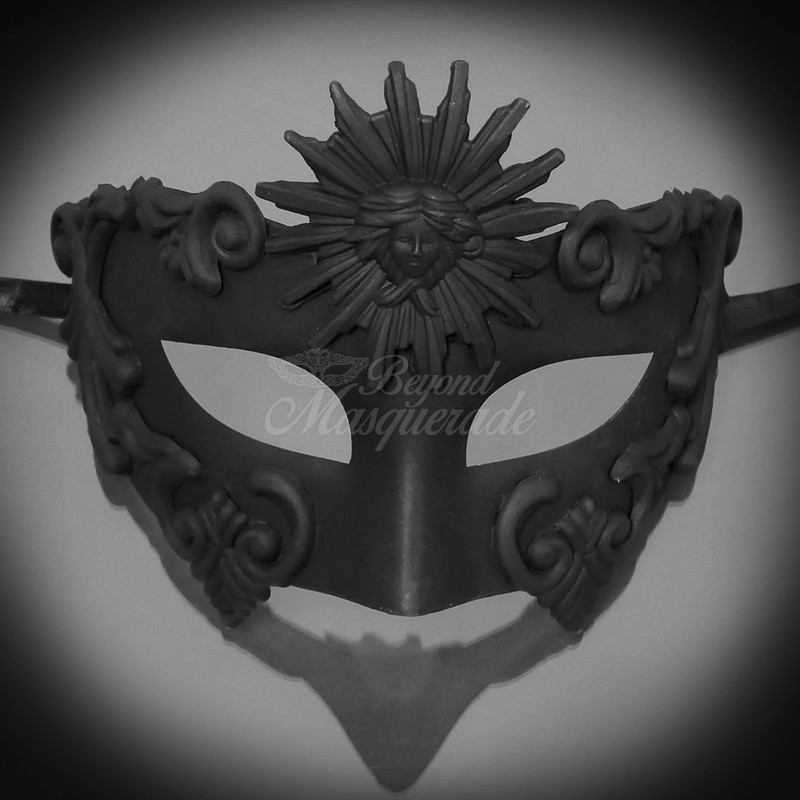
In terms of design, I have been doing research into mask types in use during Carnival. Many masks seem to be inspired by Commedia masks, with the exaggerated facial features for the men’s masks. By contrast, the women often wear simple black masks, either half masks or full round masks with no mouth opening. I like the contrast, between the women’s simple need for anonymity and the men’s use of that anonymity to act out their vices and deep urges.

Masquerade masks, party masks, halloween masks, halloween costume masks, couples masquerade masks.
Possible women’s mask
Related image
Possible women’s masks

For my hypothetical production, I would like to have simpler, blanker masks for the women – perhaps not black, but ones that just serve their purpose to hide their identity. To contrast, with the men, I would like to give them grotesque animal masks – many of the men give in to their animalistic urges when disguised by a mask or the dark. It is monstrous and dangerous. Perhaps, rather than pure animal masks, I would draw inspiration from the monsters and creatures of classical mythology – the Minotaur, the Cyclops, the Satyr, the Chimaera, and so on. Monstrous and grotesque.

Minotaur Stylized Mask
Satyr Mask

In addition to the masks, I would like to explore clothing layers, and how closed off the young women initially are in comparison to Angellica. Perhaps Angellica is initially very exposed, clothing-wise, but as she falls in love with Willmore, her outfits grow more modest until she realizes he truly loves another, then she is exposed and bared again when she threatens Willmore. To contrast, the young ladies are properly dressed, fully covered at the top of the show, then their Carnival outfits slowly grow more and more revealing as they become more comfortable in pursuing their desires. This provides a good contrast to Blunt, who is charmed and proper, utterly taken by Lucetta – but, once she strips him of his belongings, he is also stripped of his naivety and his propriety. He is brash and animalistic and in a rage, and in fact, he doesn’t seem to trust himself to speak to Florinda once he realizes who she is until he is dressed and tightened up again. How much people show with their clothing is always a good shorthand for how open and free they are.

Contrast the two less clothed women with the properly dressed lady in the center.

Finally, I would like to incorporate transparency in both the set and the costumes. I think there are moments where it is very important that things be more and less transparent, and I think it’s an interesting thing to play with. For example, in the set, Angellica is said to be behind a silken curtain. I would love to play with the layering of fabrics and explore how they interact with light to either reveal or hide the actor. I think that perhaps having a curtain with one layer of black lace and one layer of white chiffon could create some interesting shadows and reveals with light – if light is not shining directly on it, the curtain would appear opaque, but if a light was shone onto the curtain, it would render the chiffon translucent, revealing Angellica behind it, trapped in lace. Alternatively, Angellica could be backlit to play with shadows, or she could move one of the layers to see outside, but still remain hidden.

I would also play with transparency and what you can see through in the garden scene with Florinda. I would love to see this scene staged behind a iron scrollwork fence – one that was intricate and open enough that Florinda could be seen through it, but still a barrier. And, in my ideal world, the set would have a turntable that would turn once Willmore had entered the garden, pivoting so the audience could see how the scene unfolds, and turning back around so that by the time Pedro and the servants enter, the fence is once again between the actors and audience. I know, this is a very complex scenic design for a rather short scene, but we are emphasizing what is exposed and what is hidden. In this scene, I would also costume Florinda in a very fine, very sheer chemise, one where the shape of her body could be seen when the light shines on her. It would emphasize how exposed and vulnerable she is.

Photos Sourced From:

https://www.1001venetianmasks.com/

https://beyondmasquerade.com/roman-sun-god-masquerade-mask-black/

https://www.costumekingdom.com/p-25617-adult-black-low-poly-bull-halloween-mask.aspx

https://www.ebay.com/itm/Goat-Ram-Horns-Masquerade-Costume-Mask-Illuminati-Silver-Wall-Art-Animal-Satyr-/352236079428